








How a speck of algae changed neuroscience and led to a Nobel Prize
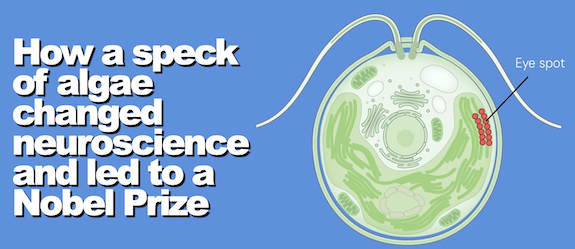
It’s an otherwise forgettable puddle by the side of Highway 2 in Iowa, just outside of Clarinda. I know, you’d rather look at the magnificent corn. But, let’s look at that little speck of algae, swimming toward the light.
That one, over there, the green speck in the puddle, moving towards the light source outside the farm gate. Yes, that little guy.
It knows where the light is. How does it know that?
It does not have an eye, or even really a proto-eye in the animal sense. No lens. No retina. No image. No brain. No visual experience. And yet—it senses the direction of the light, turns toward it and swims. How can something that cannot see know where the light is—and act on that information? How does it do that?
It was the painstaking attempt to elucidate the exact biochemical magic by which a single microscopic alga accomplished this feat that ultimately carried Peter Hegemann, Georg Nagel, and Karl Deisseroth to the 2026 Nobel Prize in Physiology or Medicine, this week, awarded for their landmark discoveries concerning light-gated ion channels and the birth of optogenetics—a breathtakingly grand destination for a narrative that began with our little green guy.
The green speck in question is Chlamydomonas reinhardtii, a single-celled green alga measuring a mere fifteen micrometres across, navigating its liquid domain through the synchronized beat of two delicate flagella while carrying within its membrane a minute, reddish-orange structure known to science as the eyespot. We know it from biofuels and materials — one of those organisms that researchers occasionally starve to see how much oil they will accumulate (a lot, by the way, this guy can be a little fatty in hard times). In truth, the term “eyespot” carries a degree of poetic misdirection, for it does not synthesize a visual representation of the external landscape, nor is there any cognitive observer within the single cell to interpret such a scene if it did. What this microscopic mechanism provides instead is something far more primordial, far more foundational to the history of life on Earth: a steady, unambiguous stream of physical data sufficient to alter the organism’s trajectory through space—a fundamental loop of sensing the surrounding world, registering a spatial differential, and mounting an immediate physical response. Long before the evolutionary emergence of compound eyes, camera-style retinas, or complex central nervous systems, the ancient lineages of life had already mastered this vital machinery of environmental awareness.
To appreciate the sheer improbability of this discovery, one must first grapple with the mind-bending speed at which these microscopic events occur. When Hegemann first began dissecting the photo-responsive behaviors of swimming algae in the early 1990s, he encountered an immediate physical paradox in the physiology of Chlamydomonas: the instant a beam of light struck the cellular body, a distinct electrical current registered across its membrane with almost miraculous speed.
In the traditional paradigms of animal vision, phototransduction is a complex, multi-tiered molecular relay race in which a photon strikes a visual receptor, triggering a cascade of secondary biochemical messengers, which in turn activate downstream effector enzymes until, after a series of signal amplification steps, an ion channel finally opens to permit electrical flux. Signal, relay, cascade, amplification, and eventual response—a process brilliant in its sensitivity, but inherently constrained by the time required for molecules to diffuse and interact across intracellular space. Yet the single-celled alga seemed to bypass this laborious multi-step relay entirely, acting with a physical immediacy that defied the established models of sensory physiology.
Faced with this temporal anomaly, Hegemann was driven to hypothesize an alternative: what if the primary light receptor and the physical pore through which electrical currents pass were not separate actors in a complex signaling chain, but were instead integrated into the selfsame molecular machine? It was a radical proposition for its time, as no ion channel known to biology had ever been observed to open directly in response to the arrival of light. For years, every attempt to isolate and characterize these elusive membrane proteins ended in frustration, as the delicate molecular structures proved notoriously unstable once extracted from the protective lipids of their native cellular environment. The breakthrough arrived only when genomic sequencing of Chlamydomonas exposed candidate genetic sequences bearing distinct structural homologies to microbial opsins—an ancient and widespread family of light-sensitive proteins.
Joining forces with Georg Nagel, a master of functional protein expression who had perfected the art of inserting foreign membrane channels into the robust eggs of the African clawed frog, the team synthesized the algal genes and embedded them into the frog cell membranes. The moment a pulse of blue light illuminated the experimental chamber, the channels swung open almost instantaneously, establishing beyond doubt that the light absorber and the electrical pore were united in a single, breathtakingly compact molecular architecture where the light-absorbing retinal molecule sits directly within the pore-forming protein itself, allowing a incoming photon to act not as a distant signal boy sending word across the cell, but as the physical key that instantly turns the lock, shifting the protein’s shape, permitting the flux of ions, and driving the immediate response of the cell in a masterclass of evolutionary miniaturization known as channelrhodopsin.
Here, the narrative takes a turn into the philosophical mechanics of evolutionary history, forcing us to consider what biology had actually fashioned in the dark depths of deep time. Evolution, in its blind and untargeted tinkering, had certainly not engineered channelrhodopsin for the future benefit of human neuroscience, a discipline of which the natural world was utterly ignorant; rather, the single-celled alga was confronted with a stark, everyday survival challenge that required it to maximize light capture for photosynthesis while avoiding damaging intensities, necessitating a physical system that could sense ambient illumination fast enough to steer its tiny body through dynamic aquatic environments.
Deep within the ancient evolutionary past, living systems hit upon a brilliantly direct physical mechanism—detect the photon, open the pore, alter the electrical state of the cell, and adjust the physical motion—and because this direct conversion of light into electrical action solved an immediate ecological problem, the genetic blue-prints for this mechanism were preserved across hundreds of millions of years. This reality invites a fundamental question regarding the nature of scientific discovery: what truly persists across the vast gulfs of biological time? Beyond the survival of specific species, beyond the lineage of cellular descendants, and beyond even the persistence of particular genetic sequences, what endures is a raw, underlying physical capability—an intrinsic capacity to transmute light energy into immediate bioelectrical work, preserved because it served a humble alga, yet holding a universal utility that was never restricted to the aquatic kingdom in which it first arose.
Nature, in its restless and unceasing operations across billions of years, has conducted endless experiments across an unimaginable spectrum of ecological stresses, physical extremes, and evolutionary opportunities. When a robust physiological strategy emerges from this vast evolutionary forge, living systems preserve it, refine it, cross-pollinate it with other biological innovations, and occasionally rediscover it through entirely independent evolutionary trajectories, demonstrating that the original evolutionary function of a biological trait rarely dictates its ultimate utility. Every so often, a completely different organism pauses to observe these ancient biological solutions, and in this particular chapter of planetary history, that observing organism happened to be humanity.
As it turned out, the field of modern neuroscience was grappling with a methodological crisis whose exact solution was mirrored in the machinery of the humble alga. The human brain, an extraordinarily complex organ containing tens of billions of densely packed neurons woven into intricate, overlapping circuits, had long resisted the analytical tools of traditional experimental biology. Standard electrical stimulation was notoriously imprecise, exciting every cell and passing nerve fiber in the vicinity of an electrode, while chemical interventions were often too slow to track cellular communications that unfold on the scale of milliseconds, leaving researchers in the frustrating position of observing that certain brain regions lit up during states of fear, motion, memory retrieval, or sleep, without ever being able to prove whether those specific neural fires were the true cause of the behavior or merely an incidental byproduct. What neuroscientists desperately required was a precise, targeted biological switch—a mechanism that could selectively activate or silence one specific subclass of neurons while leaving their immediate neighbors completely undisturbed, allowing researchers to draw true causal lines through the dense wiring of the central nervous system.
When Francis Crick contemplated this profound experimental bottleneck in 1999, he speculated that the ideal remote-control signal for modulating individual neural circuits might ultimately prove to be light itself, though at the time, the idea of using light to control the internal electrical dynamics of living mammalian brain cells sounded like pure scientific fantasy. Yet that seemingly improbable dream became a tangible laboratory reality when Karl Deisseroth and his visionary collaborators successfully transplanted the genetic sequence for algal channelrhodopsin directly into mammalian neurons, instructing the brain cells to manufacture the ancient algal protein and embed it within their own cell membranes. The results were instantaneous and revolutionary: when pulses of blue light were directed onto these engineered neurons, the channelrhodopsin pores swung open, ions rushed across the cellular membranes, and the neurons fired precisely on command, effectively granting neuroscientists the universal light-switch they had sought for over a century.
Almost overnight, what had once been an abstract theoretical concept transformed into an astonishingly direct physical tool for interrogating the brain. Researchers were soon threading micro-optical fibers into the brains of living, active mice, delivering precisely timed flashes of laser light into targeted motor networks to command the movement of individual whiskers in real time—a startling display of biological causality unfolding directly before the experimenter’s eyes. Across laboratories worldwide, scientists deployed these light-driven switches to dissect the deep neural circuitry governing fear conditioning, reward processing, memory consolidation, and sleep architecture, moving beyond passive observation to actively drive specific neural pathways and observe the resulting behavioral shifts. Far from remaining confined to basic rodent research, this technology eventually crossed over into clinical human medicine, where scientists working with patients suffering from degenerative blindness caused by retinitis pigmentosa inserted microbial light-sensitive channel proteins into surviving retinal cells, allowing patients equipped with specialized light-amplifying goggles to regain the ability to perceive, locate, and interact with physical objects in their environment—a breathtaking trajectory wherein a primitive algal strategy for swimming toward sunlight crossed biological kingdoms to restore visual perception to the human eye, representing an astonishing return on an investigation that began with a simple curiosity about why a microscopic green speck moved across a dish.
This remarkable arc underscores the fundamental paradox of scientific progress and highlights the kind of foundational research project that no modern corporate panel or targeted funding committee would ever have approved under conventional metrics. If one were to write a formal research proposal in 1990 requesting public funds to determine why a microscopic green alga swims toward light, the standard metrics of commercial utility would have deemed it thoroughly unviable: the immediate market potential was entirely non-existent, the specific disease it aimed to cure was completely unspecified, the industrial applications were wholly unknown, and its eventual, revolutionary contribution to human neuroscience was something that no living scientist could have possibly predicted or articulated. This is the indispensable territory of basic research, the undiscovered country, which must be clearly distinguished from applied science. In the landscape of human knowledge, there exist known-knowns—established capabilities that we understand well enough to refine into superior industrial products and medical devices; there exist known-unknowns—clearly defined clinical or technological objectives whose final solutions remain to be engineered through targeted applied research; and then, most crucially, there exist the unknown-unknowns—those profound territories where we cannot map the route simply because we do not yet realize that the destination even exists.
While the concept of “unknown-unknowns” is frequently invoked in engineering and management as a dire warning against unexpected failures that can derail a project, this profound uncertainty contains a far more triumphant truth: it is precisely within the realm of the unknown-unknowns that genuine, game-changing human discoveries reside. Basic, curiosity-driven science serves as the essential institutional engine by which civilization systematically transforms unknown-unknowns into known-unknowns, occasionally yielding new capabilities of monumental value that no central planner could ever have scheduled or commanded. It would have been utterly nonsensical to commission Hegemann in 1990 to investigate the phototaxis of green algae for the explicit purpose of giving neuroscientists a tool to switch individual mammalian neurons on with blue light fifteen years later, precisely because human civilization did not yet possess enough fundamental knowledge to even frame such a request—and that inherent unpredictability is the vital point that modern research management so often overlooks.
Consider, by way of analogy, the famed story of Swiss engineer George de Mestral, who returned from a routine hunting walk in the countryside to find his trousers and his dog’s fur covered in persistent burrs—an everyday annoyance that countless humans had experienced for thousands of years without a second thought. Rather than simply brushing them off and moving on with his day, de Mestral possessed the scientific curiosity to examine the persistent plant structures under magnification, discovering a dense array of tiny, flexible hooks that reliably caught upon the microscopic loops of fabric and animal hair, revealing that nature had already engineered a remarkably effective mechanical joining system. The resulting multi-year effort to synthesize this biological mechanism out of woven nylon produced Velcro, demonstrating that the transformative moment in technological history was not the industrial manufacturing of hook-and-loop tape itself, but rather the quiet, curious decision to stop and inspect the burr. Nature had perfected the underlying physical capability millions of years before humanity conceived of the industrial application; the burr clings to the fabric, the single-celled alga swims toward the sun, and while the vast majority of the world walks past without taking notice, the entire trajectory of human knowledge hinges upon the solitary individual who pauses to ask: how does it do that?
We are accustomed to speaking of human curiosity as if it were merely a charming personal trait or a pleasant intellectual pastime, but in the rigorous architecture of scientific and economic progress, curiosity is nothing less than foundational infrastructure. While targeted applied research remains utterly essential for refining known tools—such as optimizing channelrhodopsin expression in specific mammalian cell types, designing advanced fiber-optic delivery systems, and conducting clinical trials to establish human safety—such downstream development can only occur after basic exploration has uncovered the fundamental phenomenon in the first place. This distinction carries an urgent warning for the modern era, wherein scientific research is increasingly coerced to justify its existence prior to commencement through strict commercial milestones, pre-articulated market applications, and predictable economic returns. A scientific ecosystem that exclusively funds projects capable of describing their ultimate commercial deliverables before the actual work has even begun will systematically sterilize the research environment, ensuring that revolutionary discoveries disguised as obscure biological anomalies are routinely overlooked and discarded.
A future technological revolution comparable to optogenetics will almost certainly not arrive neatly packaged as a high-concept business plan, but will instead enter the world disguised as an intriguing anomaly—an unexpected nuisance in an experiment, an odd biological quirk that fails to match current textbook models, an obscure organism surviving in an environment where it ought to perish, or a metabolic pathway operating at a speed that violates established physiological assumptions. When confronted with these extraordinary deviations from the expected norm, the most vital response for the advancement of human civilization is not the immediate, utilitarian demand to know what product can be manufactured and sold from it, but rather the deeper, far more transformative impulse to uncover the underlying mechanisms that govern how it actually functions.
This philosophical imperative carries profound implications for the global algae research community, which currently dedicates an immense amount of intellectual capital and financial resource toward forcing algal systems to yield products whose industrial utility is already well understood. We endlessly interrogate these photosynthetic organisms for higher lipid yields, elevated protein content, richer pigment concentrations, superior volumetric productivity, cheaper biofuels, high-value specialty chemicals, functional polymers, health-promoting omega-3 fatty acids, and maximized carbon sequestration rates per acre—all of which represent undeniably crucial technical goals aimed at solving well-defined, contemporary industrial problems. Yet the grand history of channelrhodopsin demands that we expand our scientific horizons beyond merely asking what existing commodities algae can be coerced to manufacture, urging us instead to investigate the vast, untapped spectrum of what algae can fundamentally do.
Over hundreds of millions of years of evolutionary diversification, algae have confronted and solved an extraordinary array of biological challenges, developing specialized molecular machinery for hyper-efficient light harvesting, rapid ion channel gating, extreme osmotic regulation, structural resilience under ocean mechanical stress, complex chemical defense, nutrient scavenging in barren waters, and survival under extreme thermal and radiative conditions. Certain species construct intricate, high-strength extracellular polysaccharides capable of enduring the continuous, violent mechanical pounding of coastal surf; others thrive in hyper-saline lakes, polar ice sheets, or boiling thermal springs that would instantly denature the cellular machinery of less specialized organisms; still others synthesize complex secondary metabolites whose ecological and biochemical functions we are only beginning to comprehend. Tucked away within the immense, largely unmapped diversity of the algal kingdoms are countless biological capabilities that we currently treat as commercially irrelevant for one simple reason: we have not yet acquired the scientific foresight to realize what extraordinary human technologies they will eventually enable.
This reality establishes a clear ethical and strategic responsibility not only for working phycologists and molecular biologists, but for the institutional oversight bodies that dictate the allocation of scientific capital and shape the trajectory of national research agendas. Government funding agencies must make it a priority to safeguard dedicated, unencumbered research funds where the sole required deliverable is fundamental biological understanding rather than a pre-determined industrial prototype; biotechnology firms should institute open-ended prospecting units designed to search for unusual biological mechanisms long before assigning them to explicit market verticals; culture collections and genomic repositories must preserve obscure, non-model organisms precisely because today’s economically irrelevant trait may contain the foundational blueprint for tomorrow’s enabling technology; and scientific institutions must afford visionary researchers the intellectual freedom to follow an organism that exhibits strange behavior, rather than restricting support to those species that are already bound to an established corporate strategy. Whether we choose to label this philosophy as exploratory biology, biological prospecting, or basic curiosity-driven inquiry, the specific terminology is far less important than preserving the unfettered institutional freedom to execute its core methodology: locate the extraordinary biological anomaly, rigorously characterize its internal mechanisms, understand how it functions and why it persisted through evolutionary time, and then plasticize that fundamental capability—abstracting it away from the specific host organism and natural environment so that it can be redeployed to solve entirely new challenges across human technology and medicine.
That is the true, enduring legacy of channelrhodopsin, a story that did not originate in a corporate boardroom or a targeted medical initiative to map the human brain, but began instead with a microscopic green dot steering itself through the water toward a beam of light. It possessed no eye, no retina, and no nervous system, yet it navigated its aquatic world with absolute directional certainty, prompting Peter Hegemann to spend decades asking the simple, profound question of how such a thing was possible. More than thirty years later, that unyielding inquiry has yielded a Nobel Prize, gifted neuroscience one of the most experimental and emerging therapeutic technologies, and provided the global scientific community with an unforgettable reminder that nature is teeming with microscopic green dots waiting to be understood—demanding only that we possess the wisdom, patience, and curiosity to keep asking how they know.
Category: Top Stories

