








The Cornish Way: Of Green Hydrogen and a path forward
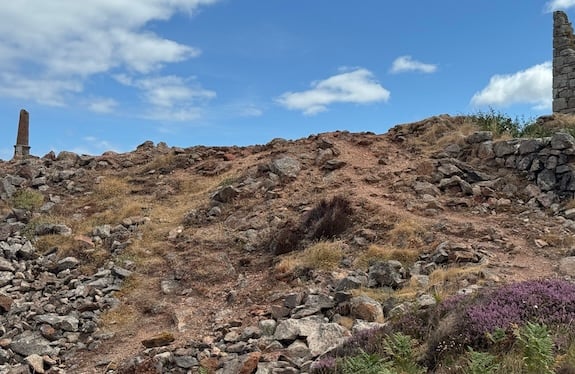
The photograph at the top of this column might puzzle you.
Some will describe it as a slag heap. Others will joke that I photographed the Poldark scenery the wrong way round. A mining engineer might see traces of copper still waiting to be recovered; a battery executive might see lithium; an ecologist might see heather slowly reclaiming an industrial scar. None of them would be wrong.
I see something I call structured feedstock. What is that, you might ask?
Nature gives us resources. Civilization creates structured feedstocks: materials, capabilities, and platforms that exist only because another organized human activity came first. They are not simply leftovers. They are inheritances. They are what remains after people have invested capital, built infrastructure, accumulated knowledge, organized supply chains, and learned how to solve difficult problems. The physical material remains, but so does the civilizational structure that created it.
Once you begin looking for structured feedstocks, you see them everywhere. Corn stover exists because someone grew grain. Used cooking oil exists because millions of people wanted dinner, not sustainable aviation fuel. Plastic packaging exists because goods had to be transported. China clay operations extracted kaolin, but left behind water networks, boreholes, and geological data. Every one of them is a resource created by a prior economic purpose.
The bioeconomy is the art of discovering value in these inheritances. Its greatest opportunities rarely begin by inventing an entirely new resource out of thin air, but by asking what yesterday’s industries have already organized into existence.
Cornwall itself may be Britain’s ultimate structured feedstock.
We often write economic history as though civilizations survive through a simple game of leapfrog, abandoning one dead industry to land on the next. Tin gives way to copper; copper gives way to china clay; china clay gives way to tourism; tourism gives way to offshore wind, lithium, and hydrogen. It sounds tidy, but it is fundamentally wrong. Cornwall did not survive across centuries because it kept inventing entirely new economies from scratch. It survived because each generation kept discovering a new purpose for structures the previous generation had already built.
Walk across the peninsula from Botallack to St Austell and you see this process unfolding in real time. Four Zeros Energy and Norway’s Vergia recently announced plans for a major hydrogen project intended to help decarbonize regional manufacturing. Read in isolation, it sounds like another clean-energy headline—another technology, another corporate partnership, another financing story. But the green hydrogen project is not merely occupying Cornish land; it is inheriting Cornish structure.
In St Austell, two centuries of kaolin extraction left great white spoil heaps that became as iconic as granite cliffs. Today, those exact same landscapes are being re-evaluated for lithium extraction, deep geothermal energy, and hydrogen logistics. The granite never changed. Only the questions did.
A day later in St Ives, the seafood was everywhere; the fishing boats were almost nowhere. It looked like decline. It was actually repurposing. The settlement itself had become the infrastructure, converting its history, beauty, and atmosphere into a high-value experience economy.
Some opportunities simply intersect. A subsidy appears, commodity prices rise, capital arrives, and then all three disappear together. Those moments rarely last. The enduring transitions occur when two industries begin reinforcing one another—when each lowers the other’s costs, strengthens the other’s markets, or creates the other’s feedstocks. That is not an intersection. It is a braid.
Cornwall exports something even more enduring than tin, copper, or visitor experiences. It exports an identity that functions as an economic input. People purchase participation in its craft, art, and culture, keeping physical communities solvent long enough for new industrial possibilities to take root. Identity becomes a civilizational resource—a shared belief that yesterday’s success is not an ending, but an inheritance.
This is the ultimate shift in perspective. We started by asking how to utilize industrial waste; we ended by asking how civilizations persist. Solving waste utilization is an engineering problem, but understanding the Cornish Way is an evolutionary principle. It shifts our unit of analysis away from isolated green-energy projects in a vacuum and toward the multigenerational continuity of productive systems. Traditional economics prioritizes finite natural resources—deposits of ore, coal, or timber. But Cornwall demonstrates that the most enduring assets are civilizational resources: engineering capability, industrial culture, institutional trust, craftsmanship, and local identity.
Standing among the mine workings at Botallack, I realized Cornwall was never really asking…”What else can this become?” It was asking something far subtler: “What else has this already become that we haven’t noticed yet?”
Lithium was already there. Used cooking oil was already there. Methane was already there. The hydrogen infrastructure was latent. The opportunity preceded its recognition. The rocks never remembered they were once tin. The harbours never cared whether they loaded copper, china clay, or tourists. Only people mistake purpose for permanence.
In the fictional Poldark series of novels, Ross Poldark believed Cornwall’s future depended upon saving its mines. History quietly chose another path. Cornwall did not save the mines. It saved the civilization that knew what to do after the mines. The photograph at the top of this column is not, in the end, a picture of a slag heap. It is a picture of organized possibility.
Civilizations do not endure because they preserve yesterday’s industries. They endure because they preserve the habit of discovering tomorrow’s industries inside yesterday’s successes. That, perhaps, is the true Cornish Way. And maybe we are all Cornish people, in the bioeconomy, because we find that way. And how might we describe it?
Perhaps as a quiet, relentless habit of looking at the structures they already possess and asking a single, transformative question: What else has this already become, and when will we use it?
Category: Top Stories

