








The Certainty Stack: Building Regional Confidence for Economic Harvest
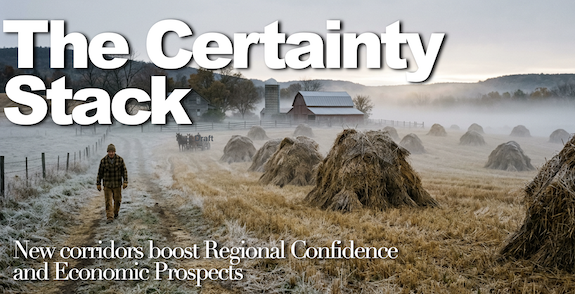
The thermometer on the machine shed reads 37 degrees.
Yesterday it touched seventy. Overnight, a cold front swept down from the Dakotas, leaving a skim of ice in the puddles and a hard northwest wind cutting across Tom Jensen’s fields outside York, Nebraska. The planter sits ready. The seed corn has already been delivered. Diesel tanks are full. Coffee has long since gone cold.
Tom stands with one gloved hand resting on the planter, looking not at the machine, but at the sky.
Should he plant today?
If he waits another week, the soil will warm and germination will be stronger—or perhaps Friday’s forecast turns into four inches of rain, leaving the fields inaccessible for another ten days. If he plants now, perhaps the cold passes and he catches the perfect growing season—or another frost comes behind it, thinning emergence before the first leaves ever break the soil.
No weather app can answer the question. Neither can the commodity markets, nor the agricultural economist on the radio, nor the extension agent in Lincoln. Tom’s grandfather used to say farming was an exercise in optimism. Tom knows better: it is an exercise in information.
The weather isn’t his deepest problem, nor are commodity prices. He cannot command either one. His real danger is leaving more uncertainty on the table than the farm can safely bear.
Tom’s first work each morning and his last work each night is to reduce the unknowns. He studies overnight temperatures. He checks the soil. He listens to the markets. He walks the machinery. He talks to farmers who planted yesterday. Every question answered becomes one less uncertainty carried into tomorrow.
The lines on Tom’s face were not carved there by frost, drought, corn borers, soybean rust, fertilizer prices, diesel costs, or interest rates. Those are merely the temporary forms uncertainty happens to take this year. If enough of those uncertainties resolve against him, someone else will eventually farm this ground. Perhaps he will find honest work driving a truck out of Scottsbluff or processing sugar beets in Bayard. There is dignity in both professions, but they are not this life.
Every spring, Tom plants corn. What he is really planting is independence.
The Enemy of Freedom
People often say that farmers battle the weather. They don’t.
The weather is merely one messenger. The real adversary is the unexpected adverse event: a late frost, a disease outbreak, a collapse in commodity prices, a bridge washed out before harvest, a broken gearbox during planting. The event itself is not always avoidable; what matters is whether it arrives unexpectedly.
Every uncertainty left unresolved eventually becomes a consequence endured. For thousands of years, agriculture has therefore pursued a remarkably simple objective: convert as many unknowns into knowns as possible.
Not because total certainty can ever be achieved—it cannot—but because once an unknown becomes understood, uncertainty transforms into risk. Risk can be hedged, financed, engineered around.
Uncertainty can do none of those things. That may be the oldest lesson in agriculture, and it is rapidly becoming the newest lesson in the global bioeconomy.
The Haystack
By August, Tom Jensen is stacking hay. To the untrained eye, it looks like simple, backbreaking manual labor. To a farmer, it is something entirely different. It is knowledge made tangible. Every bale says the same thing: we have already answered one of winter’s questions.
Every bale represents another question that has already been answered. Will there be feed in January? Yes. Will the cattle survive until spring? Almost certainly. A farm survives not by eliminating uncertainty, but by refusing to leave more of it unresolved than it can bear.
The haystack does not stop winter—it stops winter from becoming catastrophe.
For thousands of years, agrarian civilization has quietly practiced one of humanity’s oldest disciplines: converting future uncertainty into present preparation. The squirrel stores acorns; the beaver builds a dam; the swallow weaves a nest; the farmer builds a haystack. Nature itself is an interconnected web of certainty stacks.
Nebraska’s New Haystack
With that image in mind, turn from Tom’s field toward the eleven counties stretching between Lincoln and Omaha that now comprise the newly announced AgWorks Corridor.
The press releases speak of value-added agriculture, research partnerships, commercialization, advanced manufacturing, logistics, and talent pipelines. All true. But something much deeper is happening: the region is building a haystack. Not from alfalfa, but from information—or, perhaps more accurately, from the accumulated answers to thousands of questions that future entrepreneurs will never need to ask again.
The Certainty Stack
A real haystack is never built from roadside weeds gathered at random. Every bale is selected because someone knows it will matter months down the road. Economic development functions identically: every successful commercialization corridor quietly assembles its own Certainty Stack.
- One bale is a land-grant university graduating specialized fermentation scientists every spring.
- Another is a community college training operators who already understand industrial bioprocessing.
- Another is an engineering firm that has commissioned dozens of ethanol plants and knows precisely where first-of-a-kind projects fail.
- Another is a regulator who has already permitted similar facilities, or an investor who has financed the technology before.
- Another is an off-take partner fifty miles away instead of five hundred, and a regional supplier whose technician can be on-site before lunch.
Each is information. Each represents experience. Each is an answered question. None guarantees success, but together, they make failure dramatically less likely.
Within the AgWorks Corridor, agriculture already supports roughly one in every four jobs. More than 700 companies and 37,000 specialists create an agricultural capability 66 percent greater than the national average. Those statistics matter less for their raw numbers than for what they represent: accumulated knowledge, institutional memory, and informational infrastructure. They are the foundational bales in the stack.
- Phibro Animal Health did not simply choose Omaha because of geography; it found a workforce whose accumulated experience reduces operational uncertainty.
- Huvepharma inherited far more than laboratory space in Lincoln; it inherited researchers, regulators, collaborators, and technical talent already solving the exact problems it would otherwise need years to discover for itself.
- At the Cargill Blair campus, expanding companies discover something far more valuable than stainless steel tanks: they discover corporate neighbors who have already made tomorrow’s mistakes yesterday.
That accumulated information may be the most valuable infrastructure any region possesses.
The Bank Doesn’t Build the Haystack
There is a subtle inversion here that traditional economic development routinely overlooks. Farmers build haystacks; banks finance farms. The order matters.
A lender in a downtown Omaha tower does not manufacture confidence—he merely recognizes it. Every unanswered question eventually appears somewhere else: usually on the balance sheet, and often disguised as interest.
Economists correctly teach that interest compensates lenders for the time value of money. Farmers understand something equally important: much of an interest rate compensates lenders for uncertainty.
- Can the technology scale?
- Will feedstocks arrive on schedule?
- Can operators be hired?
- Will permitting finish on schedule?
- Will customers perform?
Finance has only one way to answer questions it cannot resolve itself: it charges more. Capital is relatively inexpensive; uncertainty is extraordinarily expensive.
Corridors Compress Uncertainty
This is why regional corridors matter. They are not simply collections of counties sharing a brand; they are collections of answered questions.
Every experienced contractor, every proven logistics route, every functioning pilot plant, every trained operator, every successful permitting process, and every commercial startup converts another unknown into a known. That transformation possesses enormous financial value: projects move faster, become cheaper to finance, and become far more understandable.
A lender observing fewer unknowns demands a smaller uncertainty premium. Across hundreds of millions of dollars and decades of debt service, that becomes genuine economic development—not through public subsidies, but through information.
Thinking Like a Watershed
Perhaps this is the true lesson of AgWorks: the Midwest should stop thinking like a collection of competing counties and begin thinking like a watershed.
Rivers ignore county lines. So do freight railroads, supply chains, specialized talent, venture capital, and economic uncertainty. The I-80 corridor between Lincoln and Omaha succeeds precisely because it pools knowledge, manufacturing capability, financial capital, logistics, and agriculture into a single commercial landscape.
Tomorrow, that geography naturally extends into Iowa—anchored by the high-growth tech and research integration of the I-380 Corridor, the multi-county agricultural retention of the Iowa Lakes Corridor, and the credit-buffering capital networks of the North Iowa Corridor. From there, it reaches into Kansas, Missouri, South Dakota, and eventually the entire Mississippi Basin. This is not a political map; it is a geography of shared information and reduced uncertainty.
Preparing for Winter
Winter cannot be negotiated with. Every farmer knows this in his bones; it can only be understood, then prepared for.
The bioeconomy will inevitably face its own winters: feedstock disruptions, regulatory delays, equipment failures, commodity cycles, capital shortages, and labor bottlenecks. None can be eliminated, but every single one can become less unknown.
That, perhaps, is the true work of regional economic development: not attracting companies, not issuing press releases, and not cutting ribbons, but patiently converting unknowns into knowns until what remains is no longer unknowable, but simply manageable.
Winter has a remarkable way of revealing who stacked hay in August. The same will prove true of regions. Those that methodically accumulate information, experience, trust, infrastructure, relationships, and institutional memory will discover that prosperity is rarely accidental. Like Tom Jensen’s harvest, it was planted months—and often years—before anyone noticed it growing. You see, a grower really doesn’t need more help, he needs fewer unknowns.
Category: Top Stories

