









The Woolsey Doctrine: Remembering R. James Woolsey
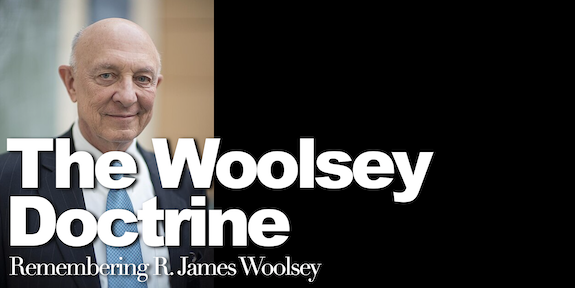
There was a time when those of us who knew Jim Woolsey—and had long marveled at a life carved so deeply into the granite of public service—half-believed the man might simply outlast mortality itself. Yet as we mark his passing this week at the age of eighty-four, we are brought face-to-face with a truth far older than statecraft: men pass, ideas endure, and Jim’s may well outshine the century that forged them.
One year at ABLC, I committed one of the more spectacular blunders of my professional life.
Jim had just slipped back into the country after quiet, secret, grueling sessions in Pyongyang during the darkest heat of the North Korean nuclear negotiations. Backstage, moments before we were to step into the lights, he mentioned his itinerary in a low voice—not to weave a tale of cloak-and-dagger diplomacy, but merely as an apology for looking worn around the eyes. It was shared in strict confidence. Minutes later, standing under the house lights before hundreds of industry leaders with a live microphone in my hand, I announced to the entire auditorium that Jim had just returned from North Korea.
He never flinched. He never corrected me, never shifted in his seat, and never offered the room even a flicker of embarrassment. He simply absorbed the misstep, stepped to the podium, and carried the discussion forward into deep geopolitical waters as though nothing untoward had transpired. In the upstairs of the Mayflower Hotel afterward, there was no lecture, no subtle flash of irritation, and no wounded vanity. Instead, we spent a happy hour introducing his friends to some of mine; they profited therefrom, and all was well.
That understated grace was pure Woolsey. But it was matched always by a mind of immense historical reach.
With a historian’s long view, Jim would often remind us that for hundreds of years, the rise and fall of empires, the maneuvering of battle fleets, and the wealth of great merchant dynasties hinged entirely upon the trade in salt—right up to the morning mechanical refrigeration quietly arrived. When cold storage took hold, salt did not vanish from the earth, nor did it lose its fundamental utility to human life. It simply ceased to be a weapon. It became ordinary.
That transformation, to Jim Woolsey’s way of thinking, represented civilization’s most brilliant operational trick: not the dramatic destruction of a critical resource, but the systematic dismantling of the strategic leverage that made it dangerous.
Salt had once underwritten royal treasuries. Pepper had drawn Spanish and Dutch armadas across uncharted oceans. Obsidian had armored ancient empires. Today, they sit in quiet glass shakers and kitchen pantries, stripped of their power to hold nations hostage—not because they became scarce, but because human ingenuity made them universal.
Jim believed with every fiber of his strategic intellect that crude oil deserved precisely the same fate.
It was never that he harbored some personal vendetta against petroleum; he was far too pragmatic for ideological grudges. He simply loved human freedom and national security vastly more.
The world remembers Woolsey as Director of Central Intelligence, as a cool-headed diplomat, and as one of the premier national security architects of the post-Cold War era. But I recall a quieter conversation regarding Pyongyang. His paramount worry was not merely the horror of a localized nuclear detonation, but the insidious threat of an electromagnetic pulse attack—a high-altitude burst designed not to level buildings, but to silently fry the delicate power grids and digital arteries upon which modern civilization relies.
That was classic Woolsey: looking past the immediate tactical flashpoint to target the systemic vulnerability beneath. He rarely wasted breath asking how to defeat a specific adversary in the field; he asked how to strip that adversary of the leverage required to coerce us in the first place.
His answer was almost mathematical in its consistency: shatter concentration, disperse risk, build deep operational redundancy, and make strategic blackmail fundamentally unprofitable.
It was that exact instinct that eventually led him away from pure defense strategy and straight into the bioeconomy. To Jim, advanced biofuels were never a mere environmental boutique project or an exercise in corporate virtue signaling. They were vital, high-grade strategic infrastructure. A nation fueled by thousands of distributed biorefineries, drawing upon diverse regional feedstocks and anchored by an array of conversion technologies, is infinitely harder to intimidate than one tethered to a handful of vulnerable maritime chokepoints and fragile global supply chains. Whether the threat took the form of an EMP strike, a sudden embargo, or a naval blockade on the far side of the globe, true national resilience begins by denying our rivals the leverage that geographic concentration creates.
He understood a fundamental truth about energy that modern discourse still routinely misses: energy security is not merely a matter of pumping enough barrels to balance a spreadsheet, but of ensuring that no foreign cartel or regional despot retains the power to dictate the price of your survival. The world’s vulnerability has never resided solely in the total volume of fuel consumed, but in the immense geopolitical leverage yielded when the marginal barrel—the one that sets the price for everyone else—is controlled by unstable or hostile regimes.
Which brings us back to the lesson of salt.
The highest achievement of any transformative technology is not to remain forever novel, glamorous, or extraordinary. It is to become completely, beautifully ordinary.
No parliament debates the ethics of mechanical refrigeration. No political party campaigns on the promise of the electric grid. No consumer stands in the aisle deliberating whether salt has earned a rightful place at the dinner table. The truly great technologies dissolve into the background of daily existence, ceasing to be partisan arguments and taking their rightful place as invisible infrastructure.
The bioeconomy has not yet crossed that threshold.
We saw this structural whiplash clearly when Brent crude surged past $100 a barrel, sending global markets into a tailspin. For too many decades, biobased projects have surged forward during these brutal price spikes, only to wither the moment oil markets soften. Policy incentives arrive with grand fanfare, only to be overhauled, litigated, or allowed to expire before modern facilities can complete their capital payback windows. Investors have learned to discount promises, while the underlying chemistry and engineering have matured far faster than the public narrative that surrounds them. Biofuels remain remarkable when their ultimate strategic ambition should be to become completely unremarkable.
That is not merely a failure of public relations; it is a structural failure of national resilience.
The very word biofuel tells the world where the molecule came from and how the refinery was engineered, while communicating virtually nothing about the strategic freedom it delivers. No commercial genius at Apple would have launched the iPhone under the moniker “Rare Earth Circuit Assembly”—they sold capability, independence, and human connection, not raw metallurgy.
Meanwhile, our opponents have mastered the art of industrial branding. For an entire generation, the public’s primary interaction with renewable energy has been mediated by a bright yellow warning sticker on a gas pump warning that the product Contains Up to 10% Ethanol. Once an industry allows its identity to be defined by its detractors, even its greatest structural triumphs begin to sound like defensive rebuttals.
When faced with complexity and noise, human minds naturally retreat to what is simple and familiar. Winston Churchill grasped this perfectly; when a bureaucrat submitted a memorandum declaring that “the answer is in the affirmative,” Churchill famously struck it out and wrote in the margin, “Just write ‘Yes.'”
Resilient ideas are simple. Resilient systems are familiar. Resilient technologies are invisible.
That is the true heart of the Woolsey Doctrine: to build a platform so ubiquitous and reliable that no one feels the need to debate its right to exist.
Had anyone dared to suggest naming a commercial fuel after Jim Woolsey, he would have dismantled the idea on the spot with quiet, devastating precision. He never hunted for brass plaques or statues in the park; he hunted for structural outcomes. He wanted drop-in fuels that quietly drained strategic risk out of the global economy, precisely as cold storage drained the strategic menace out of salt. To Jim, victory was never measured by applause at a podium. Victory was measured by irrelevance—by rendering yesterday’s crises completely obsolete.
Civilizations do not secure their future by endlessly winning political arguments. They secure their future by building replacements so superior that the old arguments simply fade into historical trivia.
That is the work Jim Woolsey leaves in our hands.
We must stop clinging to yesterday’s defensive vocabulary, stop allowing tomorrow’s vital industries to be framed by yesterday’s incumbents, and build energy systems so rock-solid and redundant that they vanish seamlessly into the machinery of daily life. Abandon the laboratory jargon. Give these fuels simple, elemental, one-syllable names that command immediate trust—call it Exit, call it simply Fuel, or call it Woolseys—and then push through the hard, unglamorous work of making it as commonplace and unquestioned as salt.
We may never carve Jim Woolsey’s features into marble or cast his likeness in public bronze—and he would surely have talked us out of it if we tried. But a far quieter, more enduring monument would have suited him best: the day when energy diversity is so deeply woven into the fabric of daily life that no aggressive power can ever again wield a barrel of oil as a political weapon, and no child growing up ever remembers that there was once a great war of words over how we powered our world.
That will be Jim Woolsey’s true monument. And it will stand long after the marble has turned to dust.
Category: Top Stories

