









The feedstock bottleneck nobody talks about is at the fryer
By Buddy Klovstad, Grand Natural Inc.
Special to The Digest
The renewable diesel and SAF boom has an appetite problem. Refiners are racing to lock up low-carbon-intensity feedstock, and used cooking oil (UCO) — with a carbon intensity a fraction of virgin soybean oil — sits near the top of everyone’s list. Billions in capacity are being built on the assumption that the feedstock will show up.
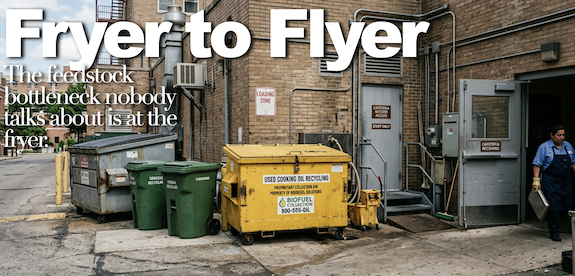
But the UCO supply chain doesn’t begin at an aggregator’s tank farm. It begins at the back door of a taqueria, a hospital cafeteria, a stadium concession stand — millions of them, each generating a few gallons a week in a bin behind the building. As a company that collects UCO from commercial kitchens across the country, we spend our days at that first mile of the supply chain, and it’s where the real constraints live. Three of them are worth the industry’s attention.
1. Collection is a logistics problem, not a commodity problem. A refinery thinks in railcars; a restaurant thinks in a 50-gallon bin that needs emptying before it overflows onto the pad. Between those two scales sits an enormous, fragmented collection network — trucks, routes, containers, and relationships with hundreds of thousands of small operators who did not get into the restaurant business to manage a feedstock supply chain. Feedstock availability, in practice, is a function of route density and service reliability, not of how much oil theoretically exists. The gallons are real; getting them into the stream consistently is the hard part.
2. Quality is decided in the kitchen, not the lab. Free fatty acid content, moisture, and contamination — the specs that determine whether a load is worth pretreating — are largely set before the oil ever leaves the restaurant. A bin left open in the rain, water from a mop bucket, or a load cut with fryer-cleaning chemicals can turn usable feedstock into a discount or a rejection. The industry tends to treat UCO as a uniform input; at the collection layer it is anything but. The collectors who invest in sealed containers, training, and consistent pickup are, in effect, doing feedstock pretreatment upstream — and that quality difference compounds all the way to the refinery.
3. Competition for the barrel is now fierce — and it’s reshaping the first mile. Not long ago, restaurants paid to have grease hauled away. Now, in many markets, collectors pay restaurants rebates for it, because the molecule is worth real money downstream. That’s a healthy sign of demand, but it has also drawn in theft, “grease rustling,” and a churn of operators chasing accounts. For refiners underwriting long-term feedstock, the lesson is that supply security depends on the stability of the collection layer — on whether the company servicing that restaurant will still be there, and still be compliant, next year.
As mandates tighten and SAF targets climb, the temptation is to hunt for the next exotic feedstock. But an enormous, under-collected pool of UCO is still going down drains and into landfills every day — not because it doesn’t exist, but because the unglamorous work of getting it out of tens of thousands of kitchens, clean and consistent, is harder than the spreadsheets assume. The companies that solve the first mile — the routes, the containers, the restaurant relationships, the compliance — are quietly determining how much of that feedstock actually reaches a refinery.
The barrel everyone wants starts in a bin behind a restaurant. It’s worth understanding what it takes to get it from there to your tank.
Buddy Klovstad is the founder of Grand Natural Inc, a nationwide company that collects used cooking oil and provides grease-trap, FOG, and kitchen-drain services for commercial kitchens.
Category: Thought Leadership, Top Stories

