








The Ethanol Bridge, Part 2: The Molecule Holding Down Fuel Prices
To understand why this happens, we must begin at the pavement. Walk up to almost any gas pump in America and you are confronted with three standard choices: Regular, Midgrade, and Premium. Beside each fuel sits a number denoting its octane rating. In simple terms, octane measures a fuel’s resistance to premature combustion—the engine “knock” that threatens performance. It is the vital attribute that allows modern engines to operate at higher compression ratios, unlocking greater power and efficiency.
Drivers pay for octane every day, whether they explicitly realize it or not. Consider today’s national averages: regular gasoline commands $3.97 per gallon, while premium commands $4.86. That is an 89-cent gulf, yet the primary chemical distinction between those two fuels is, down to it, four octane points: 87 versus 91.
The market is telegraphing a clear and vital truth: octane is valuable. Exceedingly valuable.
If we divide that 89-cent premium by those four octane numbers, the market is effectively valuing each point of octane at roughly 22 cents per gallon. Now, consider ethanol. Ethanol carries an octane rating of approximately 113. An E15 blend raises 87-octane straight gasoline to 91-octane — it’s super, and worth 88 cents more per gallon. Ethanol represents the cheapest large-scale source available on the global market we know.
When you look strictly at this chemical contribution, ethanol creates a lot of octane value. And that’s before considering that ethanol is also a fuel in its own right, carrying roughly two-thirds of the thermal energy of a gallon of gasoline. Reasonable people can debate the precise arithmetic—whether the true implied value is seven, eight, or nine dollars—but the ultimate conclusion is difficult to escape: ethanol delivers far more utility to the barrel than its market price reflects.
Which brings us to the central, strange paradox of the American fuel market.
In almost every other consumer industry, adding more of a premium ingredient drives the final price upward. Add more beef to a hamburger, and the price rises. Add more alcohol to a cocktail, and the price rises. Add more horsepower to a vehicle, and the price rises. Yet in the American fuel market, adding more of one of the most valuable, high-performance components in the entire barrel frequently lowers the price at the pump.
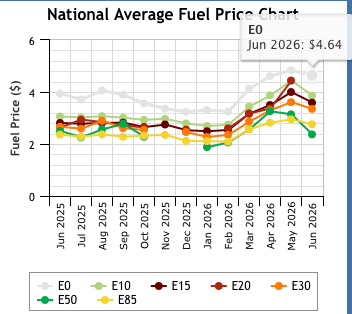
This inversion is not a flaw; it is a gift. For years, American consumers have been the unwitting beneficiaries of one of the most remarkable bargains in the broader economy. E10 is generally cheaper than ethanol-free gasoline. E15 routinely sells for less than E10. E85, according to current AAA national averages, sells for nearly a dollar less per gallon than regular gasoline, and almost two dollars less than premium.
While drivers view ethanol simply as a alternative volume of fuel, the refining industry views it as something else entirely: pure, affordable octane.
Automakers, refiners, and drivers all demand octane because modern internal combustion engines increasingly rely on high cylinder pressures. Technologies like turbochargers and direct injection depend entirely on high-octane environments to extract more work from every drop of fuel.
While the public conversation frequently frames the future of transportation as a binary choice between conventional gasoline and electric vehicles, automotive engineers see a more nuanced third pathway: what if engines were optimized around our cheapest source of octane, rather than merely treating it as an additive?
This question leads directly to E30. At a rating of around 95 octane, E30 offers an opportunity to build ultra-high-compression engines that are cleaner, more efficient, and far less dependent on expensive, petroleum-derived aromatics. It sits at a perfect macroeconomic intersection: America’s farms continue to produce record grain yields, and modern powertrains continue to demand higher octane. Ethanol supplies that need seamlessly and economically.
Suppose a supplier offered an industrial product that delivered one of the most valuable performance attributes in your entire system while simultaneously providing usable energy. You would expect that product to command a historic premium. Instead, the market has behaved upside down.
 The fuel industry rarely articulates this bargain because molecular chemistry remains largely invisible to the average driver. Consumers see the final price on the marquee, not the refining economics behind it. But the chemistry matters immensely. Without ethanol, refiners would still be legally and mechanically required to manufacture or purchase octane to meet performance specifications. The difference is that they would have to rely on costlier petroleum components, and fuel prices would rise accordingly.
Critics frequently debate ethanol’s broader impacts on agriculture, land use, emissions, and trade policy. Those discussions are necessary and important. But they often obscure a simpler, foundational reality: ethanol helps produce affordable octane, and affordable octane helps produce affordable fuel. All you have to do is look at the price of straight gasoline, it’s $4.64 per gallon according to e85prices.com’s latest data.
Why does E15 cost less than E10? Why does E85 represent such a massive discount against regular gasoline? Because one of the most valuable components in the fuel system is being cleared at a fraction of the value it creates. For American drivers, it has been a quiet, persistent shield against the true volatility of global oil prices.
In Part 3, we will examine a nation that embraced this molecular bargain far more aggressively than the United States. While American drivers faced spiking fuel costs this season, Brazilian motorists possessed a powerful alternative. The difference between the two nations was not a matter of chemistry, nor geography, nor luck. It was a matter of policy.
Category: Top Stories

