








The Ethanol Bridge, Part 1: The More You Use, The More You Save

Americans disagree about so much, it’s practically the national pastime. Politics. Who pays how much in taxes. Climate change. College football rivalry games. Daylight savings time.
But there is one thing nearly everyone agrees on. Nobody likes paying too much for fuel. Every week, millions of Americans pull into a gas station hoping the number on the sign has gone down instead of up. We complain when prices rise. We blame oil companies, politicians, wars, hurricanes, refinery outages, speculators, and sometimes all of them at once.
Yet hidden in plain sight is one of the strangest facts in the American economy. The fuel that contains more ethanol is often the fuel that costs less. According to today’s national AAA averages, regular gasoline sells for $3.97 per gallon. Premium sells for $4.86. E85, meanwhile, averages just $3.06.
Think about that for a moment. The fuel containing the most ethanol is also the least expensive fuel on the board. Nor is E85 an isolated case. Across much of America, E15 regularly sells for less than conventional E10 gasoline, while E10 generally sells for less than ethanol-free gasoline.
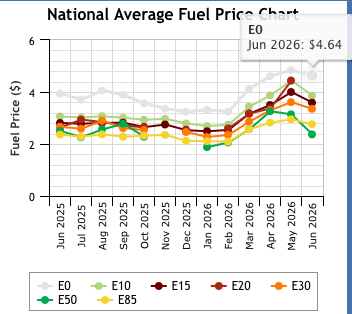
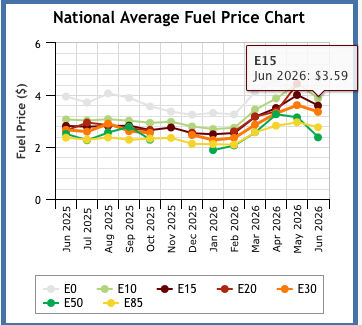
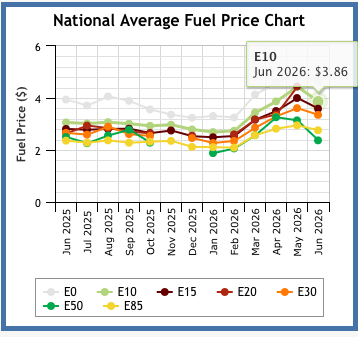
Let’s look at the most recent data from e85prices.com. The pattern is remarkably consistent. E0 selling for $4.64, E10 for $3.86, and E15 for $3.59. The more ethanol you find, the more money you save.
For years, Americans have been told that renewable fuels raise costs. Yet consumers standing at the pump today can see something quite different with their own eyes. More ethanol. Lower price. Why?
That question takes us to one of the most overlooked stories in American energy. However, what most people are told is that ethanol has lower energy density and cost-per-mile is more important than the price at the pump. I don’t believe that for a second, myself — people always look at the price at the pump. Otherwise, more of them over time would drive diesel-powered vehicles, which have 30 percent more energy density than gasoline and rarely is the diesel price 30 percent more than gasoline price.
But let’s take the argument on its merits. For sure, ethanol has 33 percent lower energy density than straight gasoline. So, a $4.64 gallon of straight gas (E0) has 3.3 percent more energy, so you’d have to buy more E10 to cover the difference, about 15 cents worth. So, your friend who quotes the energy density argument is right, and wrong. Right, ethanol has lower energy density. Wrong, the difference covers only 15 cents of the 78 cent differential. If you’re driving on E10, you’re saving money.
The same logic applies to E15. A gallon of E10 sold at $3.86 has 1.7 percent more energy, so you have to buy more E15 to cover the difference, about 6 cents worth, or the 27 cent differential. If you’re driving on E10, you’re saving money.
What does this mean? Though the arguments for renewable fuels are myriad, we can simply focus on the driver experience. A driver filling a 15-gallon tank at today’s national average prices would spend nearly $70 on straight gasoline. The same driver using E15 where available would spend about $54.
One fill-up may not seem life-changing. Yet, over time, the savings become real money. And unlike many proposed energy solutions, this one doesn’t require a new vehicle, a new charging network, or a technological breakthrough. The fuel, pumps and savings already exist. The challenge is simply finding them. That matters because America is entering an era in which affordability is becoming a national obsession.
Families are struggling with housing costs. Insurance costs. Healthcare costs. Education costs. Grocery costs. Everything seems to cost more. Fuel is one of the few expenses people encounter every week, displayed in giant numbers visible from the road. Drivers notice every nickel.
Which makes the ethanol story all the more remarkable. For decades, the conversation around ethanol has focused on agriculture, carbon emissions, energy independence, and public policy. But we could simply talk about prices, at a time when they matter. It’s not political, it’s not 2050, and you don’t have to buy a new car to save. But the story doesn’t end at the pump. The lower-cost fuel sitting beside gasoline may also be helping solve a very different problem unfolding across rural America. For most of the twentieth century, agriculture benefited from a powerful tailwind: more people. Global population grew rapidly. Food demand expanded. Today, that picture is changing. Population growth is slowing. Growth in meat consumption is slowing. Meanwhile, American farmers continue to become more productive. Every year, the nation grows more corn from roughly the same land base.
America grows more energy every spring. That is wonderful news—until demand stops growing as quickly as supply. You’ve heard about food vs fuel, I’ll bet. But it’s not really about that. We’re producing so much food at such a low price, without the fuel market, farms go out of business, and that takes food out of the system. It’s not food vs fuel, really, it’s fuel gets you food — food you can afford.
Now, I know it’s touch to go to the grocery aisle and see a box of Corn Flakes marketed for six dollars, and feel sorry for the farmer. That’s a lot of money for about a pound of corn. Until you realize that the farmer gets about 15 cents per box, for the corn. The rest of it, goes somewhere else, usually to a bank back east, in some big city. And that 15 cents is not the farmer’s profit. The grower pays for seed, equipment, labor, fertilizer and so forth — and then prays for rain.
At the same time, vehicle efficiency continues to improve, and electric vehicles are gradually reducing gasoline demand. The trend may be slow, but the direction is clear. That creates a challenge. Approximately 36 percent of U.S. corn demand is connected to ethanol production. If gasoline demand gradually falls while ethanol blends remain frozen at E10, agriculture faces the prospect of producing more while selling less. Some analyses suggest the resulting pressure could eventually affect acreage equivalent to a land mass roughly the size of North Carolina. E15 changes that equation. The blend is approved for most vehicles built since 2001—roughly 988 percent of the cars on American roads today.
Consumers save money at the pump, and in the grocery aisle, when corn enters the fuel stream. The more corn is used for fuel, the more consumers save. Yes, it’s not what you’ve been told — but consider who told you. An independent journalist with experience in the field — or a trade association with an aim to sway public opinion for commercial advantage? I don;t know where you might have heard it, but you do.
One other thing an independent journalist can tell you, after a career watching Washington DC, sometimes with a smile, often with a perplexed frown. Very few policies come around that solve more than one problem. Consumer prices, energy security and agricultural strength? When you see a policy option that comes along and solves all three, at once, and no infrastructure or large capital asset purchases required — adopt it and don’t look back.
That’s E15, in a nutshell, folks.
In part two of this series, we’ll examine the mystery behind these confounding fuel savings. Why does adding more ethanol reduce fuel costs? Why does a fuel component that drivers willingly pay for in other forms somehow make fuel cheaper rather than more expensive? The answer may surprise you. Because the molecule helping reduce fuel bills may also be one of the most valuable ingredients in the entire fuel system. More on that tomorrow.
Category: Top Stories

