








A Peacock in a Palm Tree: The Improbable Story of the Bioeconomy’s Latest Surge
Last winter on Key Biscayne, the temperature dropped low enough that frozen iguanas began falling from the palm trees. For a few hours, it looked like the end of the world. Then the sun came out. The iguanas warmed up. Now, there are more than ever.
The modern bioeconomy increasingly feels the same way. Every few months, another headwind arrives. Capital tightens. Oil prices move. Carbon policies advance or retreat. Supply chains become less predictable. Geopolitical tensions rise. A new reason appears to explain why growth should slow. Yet the sector keeps finding new places to grow.
This week alone, growth appeared in a fermentation facility in Georgia, a waste-to-energy partnership in the Philippines, and a sustainable aviation fuel complex in Brazil. Different technologies. Different geographies. Different markets. The common thread is adaptation. Like species discovering new habitats, each company has found a way around a traditional constraint. For Manus, the constraint was geography. For Tersis Technologies, it was waste. For Acelen Renewables, it was time and capital. Three challenges. Three unconventional solutions.
Escaping Geography
Like the South Florida iguana, Manus has effectively escaped its original habitat.
For decades, the world’s supply of monk fruit sweetener depended almost entirely on a single region in southern China. Geography was destiny. If harvests fluctuated, prices moved. If supply chains tightened, ingredient buyers felt the effects immediately. Manus decided to remove geography from the equation.
Operating from its Augusta BioFacility in Georgia, the company produces mogroside V—the sweet compound found in monk fruit—through precision fermentation rather than agriculture. More than thirty enzymatic steps are engineered within a single microbial production system, creating a commercial-scale supply of the sweetener without requiring the fruit itself. The result is not merely another ingredient source. It is a fundamentally different supply-chain architecture.
Instead of depending on a crop grown in one region of one country, buyers gain access to a domestic, traceable source with predictable quality and pricing. According to the company, its process requires just 6.7 percent of the land and water associated with conventional cane sugar production when normalized for sweetness, while its engineered cell factories operate at efficiencies more than 1,000 times greater than nature itself. The implications extend well beyond sweeteners.
Manus is applying the same platform to stevia, citrus-derived ingredients, and pharmaceutical precursor compounds. Most notably, the company is participating in a $47.4 million federal-private partnership under the Defense Production Act to help onshore production of critical pharmaceutical ingredients including artemisinin and shikimic acid. In each case, the pattern is the same. A supply chain once tied to geography becomes portable. Growth finds a new habitat.
Finding Value in Waste
Every year, massive blooms of sargassum seaweed arrive on Florida’s shores. Nobody invites them. Nobody orders them. Yet they arrive by the ton, driven by nutrient flows, ocean currents, weather patterns, and ecological feedback loops that span thousands of miles.
The Philippines faces its own version of unwanted biomass. Different material. Same challenge. What appears to be waste is often simply a resource waiting for a use. That is the premise behind a new partnership between Tersis Technologies and Pingkas Capital to develop waste-to-energy projects in the Republic of the Philippines.
The initial focus is a deployment in Bataan utilizing Tersis’s SynGenic V3 technology platform, which is designed to convert waste streams into energy products supporting decarbonization, hydrogen pathways, and sustainable infrastructure.
Rather than treating waste as an expense, the system seeks to transform it into a productive asset capable of generating energy, carbon credits, Renewable Energy Certificates, and other environmental attributes. The partnership itself reflects an adaptive model. Tersis contributes engineering expertise, technology deployment, and training. Pingkas Capital brings local relationships, permitting support, feedstock arrangements, and commercial development capabilities.
The strategic vision extends far beyond a single facility. Under the agreement, successful financial close of the initial Bataan project automatically extends exclusivity across ASEAN member states, transforming one project into a potential platform for regional deployment.
Antonio Uccello, CEO and Chairman of Tersis Technologies, points to the combination of feedstock availability, energy demand, and policy momentum as key drivers. The larger lesson may be simpler. Growth often appears where others see only waste.
Scaling Without Waiting
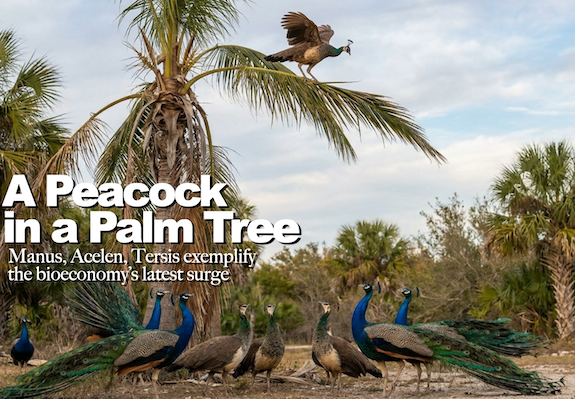
Yesterday, from my apartment on Key Biscayne, I watched a peacock fly into the top of a palm tree and balance there for nearly half an hour. What is a peacock doing in a palm tree? Adaptation runs wild, and that takes us to Brazil, where Acelen Renewables is attempting to solve one of the biggest challenges facing sustainable aviation fuel: how to scale quickly enough to meet demand.
Global SAF demand is projected to approach 500,000 barrels per day within the next decade. The challenge is not identifying demand. The challenge is building capacity rapidly enough—and economically enough—to supply it. Acelen’s answer is to rethink not only the feedstock, but also the construction model.
The company is partnering with Honeywell to deploy Ecofining technology using a modular delivery approach. Rather than constructing every component on-site, major process units are fabricated in advance and delivered as modules, reducing many of the delays, labor constraints, and cost overruns traditionally associated with large industrial projects.
It is an approach designed to compress time. Honeywell has already delivered more than 1,500 modular process units globally, demonstrating that industrial infrastructure can increasingly behave more like manufacturing and less like custom construction.
The facility will utilize macaúba oil, a native Brazilian feedstock with significant sustainability potential. Combined with Honeywell’s Ecofining process technology, the facility is expected to produce renewable fuels capable of reducing greenhouse gas emissions by up to 80 percent compared with conventional jet fuel. The feedstock is native. The engineering is global. The construction model is modular. Growth finds another pathway.
Growth Finds a Way
What struck me this week was not that these companies are pursuing sustainability. Rather, how each is responding to constraint. Geography. Waste. Construction timelines. Tight capital. Fragile supply chains. Policy uncertainty.
The traditional pathways are becoming harder to navigate. So these companies are doing what successful organisms have always done. They are adapting.
Manus escaped the limits of geography. Tersis found value in what others discard. Acelen and Honeywell found a faster route to scale.
On Key Biscayne, the iguanas survive because they found a niche. The peacock survives because it occasionally discovers that a palm tree works just as well as a forest branch. The sargassum crosses an ocean because nutrients and currents create opportunities far from their source. Growth persists because it finds another path. And in today’s bioeconomy, that may be the most valuable capability of all.
Category: Top Stories

